| Grid-Tied Solar PV |
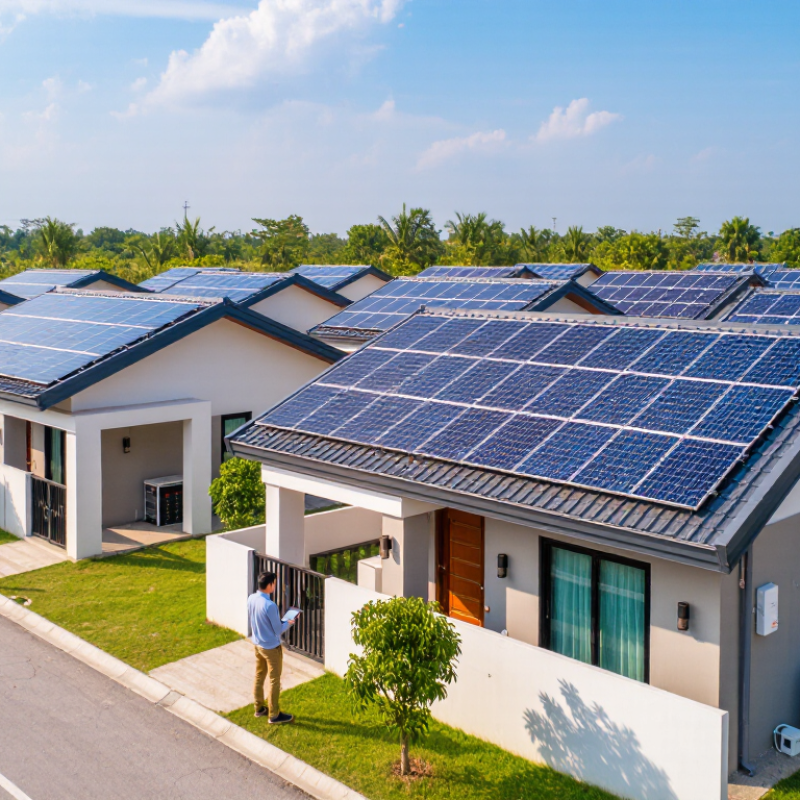
Homes with reliable utility electricity that want to reduce daytime electricity purchases. |
- Common residential size: approximately 3–10 kW DC, subject to roof area and local rules.
- Uses a grid-connected inverter.
- Normally shuts down during a grid outage unless approved backup equipment is installed.
|
Usually the simplest and lowest-cost configuration; high daytime self-consumption can reduce electricity bills. |
Confirm export limits, net-metering or feed-in rules, utility approval, anti-islanding protection, and whether the inverter is certified for the local grid code. |
| Solar PV with Battery Storage |
Homes seeking backup power, higher self-consumption, or protection from time-of-use electricity prices. |
- Compare battery usable energy in kWh, continuous output in kW, peak output, round-trip efficiency, and operating temperature.
- Check battery chemistry, enclosure rating, thermal protection, and installation location requirements.
- Review expected warranty throughput or cycle conditions.
|
Can supply selected loads during outages and shift solar energy from daytime to evening. |
Higher upfront cost and added maintenance; verify black-start capability, backup circuit capacity, fire-safety requirements, and replacement terms. |
| Hybrid Solar System |
Homes needing grid connection, solar generation, battery charging, and controlled backup in one coordinated system. |
- Confirm compatibility among PV modules, inverter, battery, meter, and energy-management controls.
- Compare backup transfer time, maximum PV input, battery charging power, and supported operating modes.
|
Flexible energy management and better integration of solar, storage, grid power, and backup loads. |
More complex commissioning; require a single-line diagram, settings record, firmware policy, and documented responsibility for system integration. |
| Off-Grid Solar System |
Remote homes or buildings without dependable utility service. |
- Must be sized from an annual and seasonal load analysis.
- Compare PV array capacity, battery autonomy in days, inverter surge rating, and backup-generator interface.
- Include winter solar resource, cloud periods, and essential-load priorities.
|
Provides electricity where grid connection is unavailable or uneconomic. |
Requires careful engineering and load management; undersized batteries or inverters can cause outages and shorten equipment life. |
| High-Temperature or Tropical Design |
Hot, humid, coastal, or high-solar-radiation locations. |
- Review module temperature coefficient, product operating temperature range, and ventilation requirements.
- Check corrosion resistance, mounting hardware materials, moisture protection, and local wind-load calculations.
|
Better long-term reliability when equipment is selected and installed for heat, humidity, salt air, and heavy rain. |
Standard indoor equipment may not be suitable outdoors; verify enclosure ratings, corrosion protection, drainage, and clearances. |
| Cold, Snowy, or High-Wind Design |
Homes in regions with snow loading, freezing temperatures, hail, or strong seasonal winds. |
- Check module mechanical-load ratings and the mounting system’s local structural calculations.
- Verify minimum operating temperatures for inverters and batteries.
- Confirm snow-shedding, roof attachment, and access requirements.
|
Improves structural safety and winter performance when the roof and equipment are correctly engineered. |
Snow, ice, and wind can increase structural loads; installer calculations must reflect the actual roof, building code, and site exposure. |
| Module Certification |
Applies to the PV modules used in the system. |
IEC 61215 should be verified as the applicable design-qualification and type-approval standard for terrestrial crystalline or thin-film PV modules. Check the exact module model, test standard edition, and certificate scope.
|
Provides evidence that the module design has undergone defined qualification tests for relevant environmental and electrical stresses. |
IEC 61215 is not a performance guarantee, lifetime guarantee, or substitute for a product warranty. Confirm that the certificate belongs to the exact model and manufacturing configuration. |
| Module Safety Certification |
Applies to electrical and construction safety of PV modules. |
IEC 61730 should be checked for PV module safety qualification, including construction and testing requirements. Verify the applicable class, certificate scope, and local electrical-code acceptance.
|
Addresses safety-related risks such as electric shock, fire, mechanical integrity, and insulation performance within the standard’s scope. |
Certification does not remove the need for correct earthing, overcurrent protection, cable management, isolation, fire access, and compliant installation. |
| Inverter Compliance |
Applies to grid-tied, hybrid, and backup-capable inverters. |
- Verify compliance with the destination country’s grid-connection rules and anti-islanding requirements.
- Compare maximum DC voltage, MPPT voltage range, maximum input current, AC output rating, efficiency, and enclosure rating.
- Check surge protection, residual-current monitoring, and remote-update controls.
|
Correct inverter selection improves energy harvest, safety, grid compatibility, and system availability. |
Certificates must cover the exact model and regional variant; an inverter approved in one country may not be accepted in another. |
| Battery Safety and Compliance |
Applies to systems using lithium-ion or other rechargeable battery storage. |
- Request evidence of applicable battery safety testing and transport documentation.
- Compare battery-management-system protections, thermal monitoring, short-circuit protection, and emergency-shutdown procedures.
- Confirm local fire, spacing, ventilation, and indoor/outdoor installation requirements.
|
Reduces installation and operational risks and clarifies how the battery should be used and maintained. |
Do not rely only on a nominal kWh figure; verify usable capacity, reserve settings, temperature limits, warranty exclusions, and end-of-life handling. |
| Product Warranty |
Protection against manufacturing defects in modules, inverters, batteries, and mounting components. |
- Compare the warranty period for each component and identify the legal warrantor.
- Check exclusions for unauthorized modification, incorrect installation, salt exposure, flooding, rodents, and abnormal environmental conditions.
- Confirm claim procedures, labor coverage, shipping responsibility, and replacement terms.
|
Clarifies the remedy available when a component fails because of a covered defect. |
Warranty duration alone is not enough; verify transferability, local service support, response times, and whether the warranty is enforceable in the buyer’s country. |
| Performance Warranty |
Most commonly associated with PV modules and their gradual output degradation. |
- Review the guaranteed output at the end of the stated term and the degradation formula.
- Distinguish first-year degradation from annual degradation in later years.
- Check whether testing, removal, shipping, and reinstallation costs are covered.
|
Provides a defined method for assessing whether module output remains above the warranted level. |
Actual energy production also depends on shading, orientation, temperature, soiling, system losses, grid availability, and maintenance. |
| Installer Qualification |
Applies to the company and personnel designing, installing, and commissioning the system. |
- Verify current electrical and construction licenses required by the destination jurisdiction.
- Request evidence of solar-specific training, battery training where applicable, insurance, and completed local projects.
- Check references for comparable roof types, climates, system sizes, and backup requirements.
|
Competent installation reduces electrical faults, roof leaks, unsafe wiring, poor yields, and warranty disputes. |
Training certificates do not replace a site-specific design; confirm who is responsible for permits, structural checks, utility interconnection, and final inspection. |
| Site Survey and System Design |
Required before accepting a final quotation. |
- Require roof measurements, shading assessment, orientation and tilt, structural review, cable routes, and electrical-panel inspection.
- Request a monthly production estimate using a recognized solar-resource method and stated assumptions.
- Confirm essential-load list and backup priorities for battery systems.
|
Creates a realistic design instead of relying on a generic system size or annual production claim. |
Be cautious if the quote is issued without a physical or documented remote site assessment, roof condition review, and local solar-resource assumptions. |
| Electrical Protection |
Applies to all PV systems, with additional requirements for batteries and backup circuits. |
- Check DC and AC isolators, overcurrent protection, surge protection, grounding or earthing, residual-current protection, and labeling.
- Verify conductor sizing, connector compatibility, enclosure ratings, and accessible emergency shutdown points.
|
Reduces risks of electric shock, fire, equipment damage, and unsafe maintenance conditions. |
Protection must follow the destination country’s electrical code and the equipment manufacturer’s installation instructions. |
| Roof and Mounting System |
Applies to pitched roofs, flat roofs, ground mounts, and lightweight structures. |
- Compare wind and snow-load calculations, attachment spacing, flashing details, corrosion resistance, and roof warranty compatibility.
- Check drainage, access pathways, module clamping zones, and allowance for thermal expansion.
|
Protects structural integrity and helps prevent leaks and premature corrosion. |
Do not accept generic mounting assumptions; the installer should document attachment points and confirm the roof has sufficient remaining service life. |
| Energy Yield and Financial Assumptions |
Used to compare quotations and estimate payback or lifetime value. |
- Compare annual kWh production, self-consumption percentage, export percentage, degradation, downtime, and electricity-price assumptions.
- Include replacement, insurance, cleaning, monitoring, financing, and battery-cycle assumptions.
|
Allows buyers to compare systems on expected delivered energy rather than only on nominal kW or purchase price. |
Payback is not guaranteed; results depend on tariffs, policy changes, weather, system availability, household load, and maintenance. |
| Monitoring and Documentation |
Applies after installation and during the warranty period. |
- Require monitoring access, commissioning records, as-built drawings, protection settings, serial-number schedules, and user manuals.
- Confirm alerts for inverter faults, low battery state of charge, communication loss, and abnormal production.
|
Helps identify faults early and supports future maintenance, warranty claims, and ownership transfer. |
Confirm data ownership, internet-dependence, privacy terms, local support, and whether the system remains usable if cloud monitoring is unavailable. |
| Permits and Grid Interconnection |
Required for most grid-connected residential systems. |
- Identify building, electrical, fire-safety, planning, and utility requirements before purchase.
- Confirm who submits applications, pays fees, arranges inspection, and receives permission to operate.
|
Reduces the risk of delayed commissioning, rejected interconnection, fines, or loss of export compensation. |
Rules vary by country, utility, voltage level, and system type; obtain written confirmation rather than relying on verbal promises. |
| After-Sales Service |
Important for buyers purchasing across borders or in regions with limited local technical support. |
- Compare local spare-parts availability, service response time, remote diagnostics, and escalation procedures.
- Confirm the installer’s planned maintenance schedule and labor rates after the initial warranty period.
|
Reliable service can reduce downtime and make warranty claims more practical. |
A low purchase price may become expensive if replacement parts, skilled technicians, or warranty processing are not available locally. |